
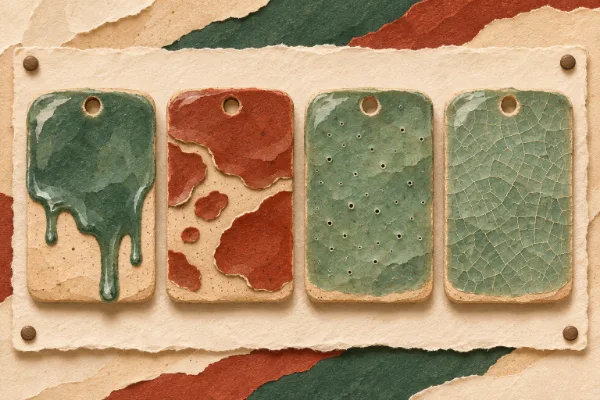
Likely causes, most relevant first
Choose a defect to see its causes.
Running
What it looks like: glaze has flowed down the wall, pooled at the foot or reached the shelf.
| Likely cause | Test to confirm |
|---|---|
| Coat too thick | Dip two tiles, one with a single dip and one with a double dip. Fire them side by side, standing at a steep angle. |
| Fired past the glaze's cone | Fire a tile with a witness cone next to it and check the cone after firing. |
| A naturally fluid glaze | Fire one tile at a steep angle with a catch dish underneath and see how far it moves at normal thickness. |
| Layered glazes melting together | Fire one tile with each glaze alone and one with both layered. Compare. |
| Glaze too close to the foot | Glaze the next test with the bottom edge left bare and compare. |
Next step: Check your recipe in Run Risk Check
Crawling
What it looks like: the glaze has pulled back into beads or islands and left bare clay, often with a thick rolled edge.
| Likely cause | Test to confirm |
|---|---|
| Dust, oil or handling marks on the bisque | Glaze two tiles: one wiped clean with a damp sponge and dried, one as it was. Fire together. |
| Coat too thick, cracking as it dried | Look at the unfired coat for cracks. Then fire a thin-coat tile beside a thick-coat tile. |
| Too much raw clay shrinking in the coat | Mix a small batch with part of the raw clay replaced by calcined clay. Fire it beside the original. |
| Poor adhesion of the coat | Add a small amount of gum or binder to a test batch and compare. |
| A stiff, high-surface-tension glaze (often matte) | Test a batch with slightly more flux and see whether it flows out. |
Next step: Check your recipe in Run Risk Check
Pinholing
What it looks like: tiny pin-sized holes in the surface, sometimes down to the clay. Pitting is similar, with slightly larger shallow craters.
| Likely cause | Test to confirm |
|---|---|
| Gas from the body or glaze escaping late, with no time to heal | Fire a tile with a hold at peak temperature beside one without. |
| Incomplete burnout in the bisque | Bisque a tile more slowly, or slightly hotter, then glaze and fire it beside a normal one. |
| Coat too thick, trapping bubbles | Fire a thin-coat tile beside a thick-coat tile. |
| Glaze underfired or too stiff to heal | Fire a tile slightly hotter and compare. |
| Gassing materials (for example zinc oxide or rutile) | Test a batch with less of that material, or a calcined version. |
Tip: rubbing visible pinholes in the unfired coat can fill them before firing.
Next step: Check your recipe in Run Risk Check
Crazing
What it looks like: a network of fine cracks in the glaze. It can appear straight from the kiln or weeks later. On functional ware it matters because cracks can hold bacteria or let liquid seep in.
| Likely cause | Test to confirm |
|---|---|
| Glaze shrinks more than the clay body on cooling (expansion mismatch) | Fire the same glaze on two different clay bodies and compare. |
| A new or changed clay body | Fire the glaze on a tile of your old body and the new body together. |
| High-expansion fluxes such as sodium and potassium | Test a batch with less soda or potash feldspar, or more silica, and compare. |
| Thick coat adding stress | Fire a thin-coat tile beside a thick-coat tile. |
| Fast cooling | Fire a tile with a slower cool. This can reduce crazing but does not fix the mismatch. |
Note: some potters use crazing on purpose in crackle glazes. On pots for food and drink, treat it as a defect, and have finished ware lab-tested if food safety is in question.
Next step: Compare a lower-expansion swap in the Material Swap Helper · Check your recipe in Run Risk Check
Coming later: blistering, shivering and dunting.