
Run Risk Check: will this glaze run?
Enter the recipe you plan to fire. Tell us the cone, how thick you apply it and what shape the pot is. You get a run risk level, the reasons behind it and changes to try. Everything is calculated in your browser.
Your result
Press “Check run risk”. The risk level comes first, then the reasons, the changes to try and the UMF table.
An estimate, not a guarantee — always fire a test tile.
What makes a glaze run
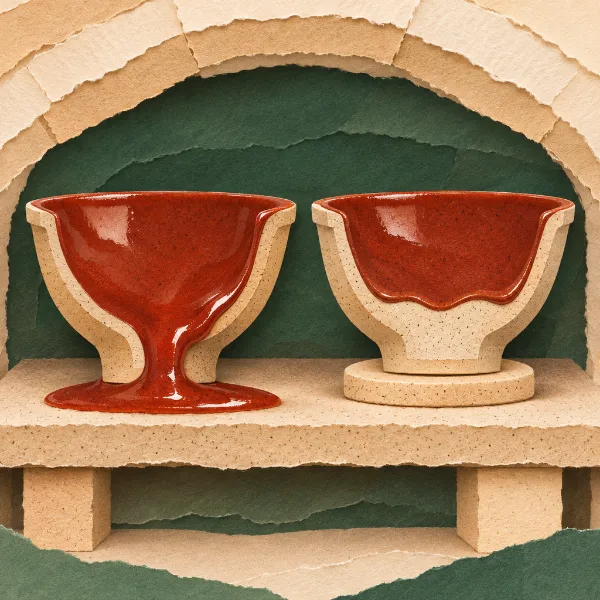
A glaze runs when it becomes fluid enough in the firing to move under its own weight. Several things push it that way, and they add up.
- Coat thickness. A thick coat holds more glaze that can flow. This is the most common reason glazes run, especially when glazes are layered.
- Firing past the glaze's cone. More heat makes the melt more fluid. If the kiln overshoots, a glaze that behaved last time can run.
- A glaze that is fluid by nature. Some glossy, glassy glazes and many high-flux glazes run even at a normal thickness.
- Layering. Two glazes that are stable alone can run when combined, because together they melt at a lower temperature.
- Glaze near the foot. Any glaze on the bottom edge has a short path to the shelf.
- Pot shape. Glaze on a tall vertical wall has more distance to travel and less to stop it than glaze on a flat plate.
Flux balance, silica:alumina and boron
Run Risk Check reports three indicators from your recipe's Unity Molecular Formula: the balance of fluxes, the ratio of silica to alumina, and the boron content. Alumina stiffens a melt; boron and the alkali fluxes (sodium, potassium, lithium) make it more fluid. A silica:alumina ratio of about 8:1 or more usually means a glossy, more mobile glass, while ratios near 5:1 and lower lean toward stiff, matte surfaces, as the Stull chart shows. The reasons panel tells you how each indicator affected your result, and where a rule is uncertain the tool leans toward the higher risk.
Protecting your kiln shelves
Even a Low result is an estimate. A few habits keep a surprise run from costing you a shelf.
- Leave the foot bare. Keep glaze a few millimetres above the bottom edge and wipe the foot with a damp sponge.
- Coat kiln shelves with kiln wash so a drip can be chipped off.
- Put a fired clay cookie or catch plate under any pot you are unsure about.
- Leave space between pots.
If a pot fuses to the shelf, don't pull it. Let the kiln cool fully, wear eye protection and a respirator rated for fine dust, and grind the glaze free, wet where possible. In a shared studio, tell the person responsible for the kiln.
How to read the UMF table
The Unity Molecular Formula expresses your glaze as oxides rather than raw materials. The fluxes are set to add up to 1.0, so you can compare silica, alumina and boron between glazes regardless of the materials used. Teachers can use the table to show why a change in materials changes the melt.
- Fluxes (R2O and RO) are the melters: sodium, potassium and lithium oxides, then calcium, magnesium, zinc, strontium and barium oxides. Together they make 1.0.
- Stabilisers (R2O3), mainly alumina, stiffen the melt. Boron sits in this group but behaves as a strong melter.
- Glass formers (RO2), mainly silica, build the glass itself.
The material analyses behind the table are typical published figures. Your supplier's data sheet for the lot you own is the better number, and the test tile has the last word.
Glaze already ran? Open the Defect Guide · Missing a material? Try the Material Swap Helper